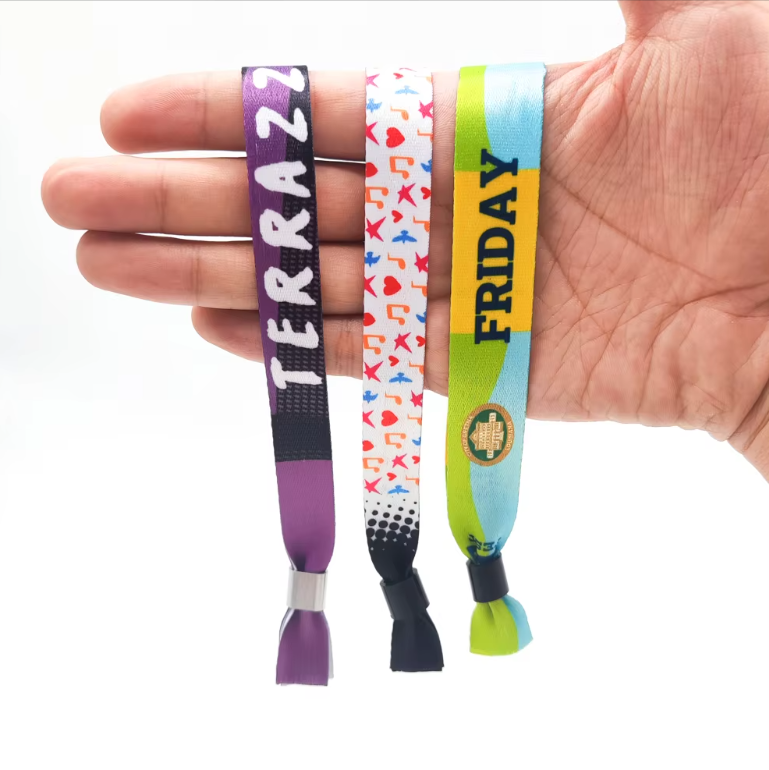
The First Physical Gatekeeper at Any Event
Event entry starts long before a ticket scanner beeps. Staff at the gate need a fast way to see who belongs inside, who has access to a specific zone, and who still needs a check. Wrist bands solve that in one glance. They are small, visible, and attached to the body, which means they cannot be easily left in a bag or lost in a pocket. Unlike lanyards that swing and flip, a wristband stays where the attendee can see it and where staff can verify it without slowing the line. That simple positional advantage is why wristbands remain a default tool in event management, even as digital ticketing grows.
Why the Wrist Beats a Badge or a Stamp
Event organizers have tried many identifiers: paper tickets, hand stamps, clip-on badges, and mobile QR codes. Each has a weakness. Paper tickets get crumpled. Stamps fade and smear. Badges flip backward or get covered by a jacket. Mobile codes require a phone with battery and signal. A wristband avoids most of these because it wraps around a body part that is almost always exposed and moves with the person. It works for children who do not carry phones, for swimmers at a pool party, and for staff who need both hands free. That reliability across different environments explains why wristbands show up at music festivals, corporate conferences, hospital wards, and school field days.
|
Identifier Type |
Hands-Free |
Water Resistance |
Hard to Transfer |
Visibility at a Distance |
|
Paper ticket |
No |
Poor |
No |
Low |
|
Hand stamp |
Yes |
Fair |
No |
Low |
|
Clip-on badge |
No |
Low |
No |
Medium |
|
Wristband |
Yes |
High |
Yes |
High |
|
Mobile QR code |
Yes |
N/A |
Yes |
Low |
The table shows the core tradeoff. Most alternatives force a choice between convenience and security. A well-made wristband delivers both at once.
Material Choice Determines How Long the System Lasts
Not all wristbands are the same. Paper and Tyvek bands are cheap but degrade quickly with sweat, rain, or hand washing. Vinyl bands resist water but can crack after repeated flexing. Woven and fabric bands last longer and feel more comfortable for multi-day wear. Silicone bands offer even greater durability but come with higher tooling costs. Event managers usually match the material to the event duration and environment. A one-day indoor seminar may do fine with Tyvek. A three-day outdoor festival with water rides and camping needs something tougher. The material decision is not about price alone. It is about how many times staff will need to reissue bands when the first ones fail.
Color Coding Turns Chaos into Manageable Zones
Events often run multiple access levels at once: general admission, VIP, staff, media, backstage, and volunteer. Wristbands make those boundaries visible without extra training. A security guard can spot a blue VIP band across a crowd and wave the person through, while a green general admission band is stopped at the same gate. This color partition system reduces verbal arguments because the rule is easy to see. It also creates a subtle social signal. Attendees notice which groups exist and adjust behavior accordingly. That may sound soft, but event psychology research from the International Festivals and Events Association has noted that visible access markers reduce gate conflicts and improve perceived organization. A wristband does not just identify, it communicates order.
A Riverside Festival Revealed the Real Cost of Cheap Bands
A riverside beer and music festival in southern China ran for two days with about eight thousand attendees. The first year, organizers used paper wristbands to save money. Rain started on the first afternoon, and by evening, many bands had peeled or become unreadable. Staff could not tell who had paid for the tasting zone. The team ended up manually checking phone screenshots at the entrance, which slowed entry to a crawl. The next year, the organizer switched to woven wristbands with color-coded edges and a simple locking clasp. Even after rain and repeated hand washing, the bands stayed readable. Gate staff reported faster checks and fewer disputes. That switch did not just improve security, it reduced the hidden labor cost of handling failed bands.
A Reliable Supplier Keeps the Whole System Moving
An event management plan is only as strong as its least predictable input. When wristbands arrive late, with wrong colors, or with clasps that fall off, the entire access control system suffers. That is why experienced buyers look for a manufacturer focused on wristband production rather than a general gift supplier. Vibbon, for example, has specialized in identification wristbands since 2007. The product range includes medical and entertainment wristbands, with stable output for markets across Europe, America, and the Middle East. That manufacturing focus means consistent sizing, reliable fasteners, and color accuracy, which are the unglamorous details that keep event entry running smoothly. When thousands of people are moving toward a gate, the last thing anyone wants is a batch of bands that cannot be trusted.
Wristbands have stayed popular in event management for a simple reason: they put a durable, visible, and hard-to-transfer identifier exactly where humans can see it, on the wrist. The best technology is often the one that disappears into the workflow, and a well-chosen wristband does exactly that.