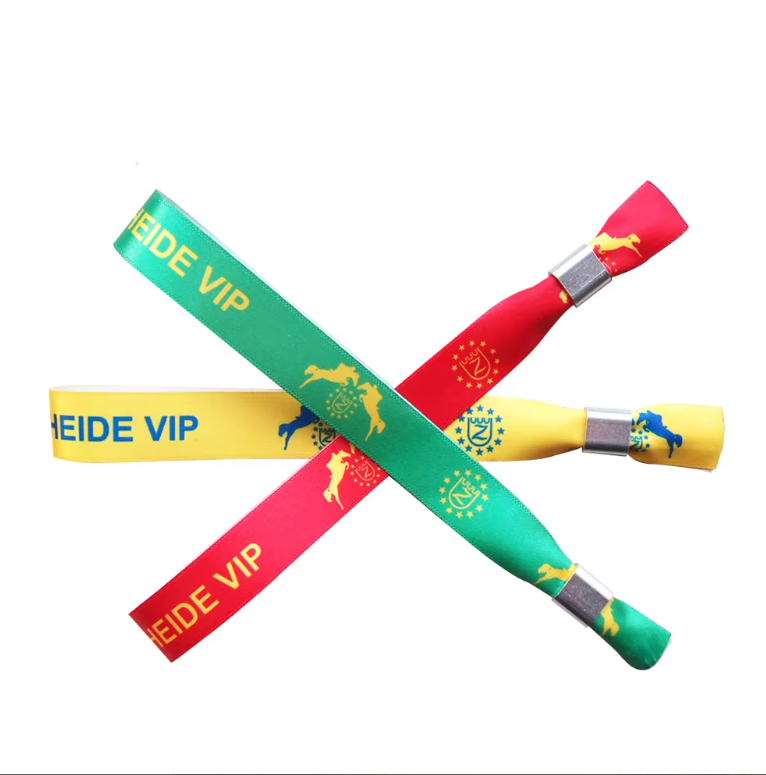
Access Control Starts with a Visual Signal
Every event entrance has the same problem: a crowd moves toward a narrow point, and someone has to decide who gets through. Security staff need a signal that is fast to read, hard to fake, and attached to the person. Wrist bands deliver exactly that. A band around the wrist sits in the peripheral vision of both the attendee and the gatekeeper. It cannot be forgotten in a bag, dropped on the floor, or held upside down. That simple visibility is the foundation of event access control. Without it, staff fall back on slower checks like phone screens, paper tickets, or verbal confirmation.
Why Paper Tickets and Stamps Fail Under Pressure
Paper tickets work in slow lines but break down when throughput matters. A folded ticket hides its section, a damp ticket smears, and a busy gate agent may not unfold it carefully. Hand stamps have the opposite problem: they are quick to apply but easy to miss on darker skin, easy to wash off, and nearly impossible to verify from a distance. Lanyards solve some visibility issues but flip around and can be borrowed by someone else between sessions. Wrist bands avoid these failure modes because the identifier stays flat, visible, and fixed to the wrist. The access decision becomes a glance, not a conversation.
|
Access Method |
Transferable? |
Visible at Distance? |
Survives Water? |
Verification Speed |
|
Paper ticket |
Yes, easily |
Low |
No |
Slow |
|
Hand stamp |
Hard but possible |
Low |
No |
Fast to apply, slow to verify |
|
Lanyard and badge |
Yes, easily |
Medium |
Depends |
Medium |
|
Wrist band with lock |
No, requires cutting |
High |
Yes |
Fast |
|
Mobile QR code |
No, tied to account |
Low |
N/A |
Medium |
The table makes one point clear: wrist bands are one of the few methods that combine non-transferability with instant visual verification. That combination is rare and valuable in event access.
The Locking Clasp Turns a Strap into a Barrier
Not every wrist band is secure. A simple adhesive band can be peeled and reattached, or slid off a small hand. A locking clasp changes that. Once the clasp is pushed through the woven or vinyl band, the only way to remove it is to cut the material. That single-use mechanism prevents casual sharing. A group cannot buy one VIP band and pass it between friends. A teenager cannot slip a general admission band to a friend waiting outside. The physical lock becomes a social contract: one band, one person, one entry. Industry guidance from the Event Safety Alliance has repeatedly emphasized that visible, non-transferable credentials reduce gate disputes and improve crowd flow. A locking wrist band matches that guidance without requiring electronic infrastructure.
Zone Management Gets Easier with Color and Pattern
Large events rarely have one access level. A convention hall may separate exhibitors, attendees, press, staff, and VIP guests. Wrist bands make those boundaries legible from several meters away. A red band with a white stripe means backstage. A blue band with a printed logo means general admission. A black band with a holographic thread means production crew. Security teams learn these codes in minutes, and attendees quickly understand where they belong. That visual language reduces repeated questioning at internal checkpoints. It also gives event organizers a low-tech fallback when Wi-Fi fails and mobile ticket apps stop loading. A wrist band does not need a charged battery or a stable signal.
A Trade Show Floor Demonstrated the Difference
A consumer electronics trade show in southern China ran three days with multiple ticketed zones. The first year, the organizer used paper badges inside plastic sleeves on lanyards. The badges flipped constantly, and staff at the premium demo area had to stop visitors to turn the badge over. Long lines formed, and several attendees shared badges between sessions to enter the paid zone. The second year, the organizer switched to woven wrist bands with locking clasps, using four colors for four access tiers. Gate staff reported faster entry, and the shared badge problem disappeared because removing a band meant cutting it. The visual color code also let roaming staff spot zone violations from across the hall. That single change reduced both friction and unauthorized access without adding electronic gates or extra personnel.
A Focused Supplier Keeps Access Predictable
Event access depends on consistency. If bands arrive late, with wrong colors, or with clasps that crack under pressure, the entire gate plan wobbles. A supplier that specializes in identification wristbands understands these variables better than a general merchandise vendor. Vibbon, for example, has focused on identification wristbands since 2007. Its production covers medical and entertainment styles, with steady output for buyers across Europe, America, and the Middle East. That narrow focus means the locking mechanism, the weave tension, and the color accuracy are treated as critical details, not afterthoughts. For an event team planning access for thousands of people, that predictability is worth more than saving a few cents per band.
Wristbands persist as an access control tool because they solve a physical problem that software alone cannot fix: a fast, visible, non-transferable credential that stays on the body. When the gates open and the crowd moves, that simple advantage becomes the difference between a smooth entry and a bottleneck.