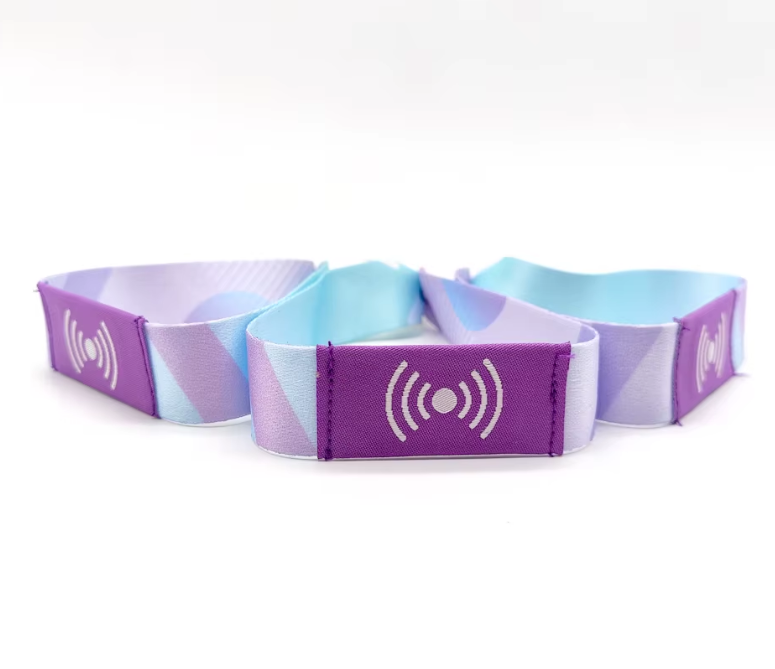
The Skin Contact Story Starts With Softness
Fabric wristbands feel comfortable first because of what touches the skin. A woven polyester or cotton band has a flexible, slightly textured surface. It bends with the wrist instead of pressing a hard, flat edge into the same spot for hours. Solid vinyl or rigid plastic tends to create a pressure line, especially when the wrist flexes during scanning, carrying, or steering. Textile bands spread that force over a wider area. Soft yarns also reduce the sharp-edge problem. A heat-cut or ultrasonic-cut fabric wristband can have a sealed edge that is smooth enough for sensitive skin, while a stamped plastic band may leave a burr if tooling wears. Standards such as OEKO-TEX Standard 100 put limits on harmful substances in textiles intended for skin contact, which matters when a band sits against the wrist through sweat, sunscreen, and repeated hand washing.
Airflow, Moisture, and the Heat Trap Problem
Comfort is not only softness. A solid band traps moisture against the skin. That moisture mixes with salt, dead skin, and friction, and the result is itching, redness, or that sticky feeling people notice after a few hours. In fabric wristbands, the gaps between warp and weft yarns let air move. Under ASTM D737, a standard test for air permeability, woven textile structures often measure in the hundreds of cubic feet per minute, while solid vinyl sits near zero. The numbers vary by weave, coating, and weight, but the direction is clear. Air moves, moisture vapor escapes, and the skin has a better chance to stay dry. A coated fabric can cut airflow significantly, so a heavy waterproof coating may solve one problem while creating another. For comfort, the sweet spot is usually a breathable weave with a print method that does not fill every pore.
Why Woven Structure Beats Flat Plastic on a Moving Wrist
Wrist movement is constant, whether lifting boxes, holding drinks, or pushing through crowds. A comfortable band has to handle all of that without digging in. Woven webbing has a natural give. It is not stretchy like rubber, but the structure can flex and recover. Flat plastic does not flex in the same way. It may bend, yet it still creates a stiff hoop that resists the wrist's shape. Fabric wristbands also conform to different wrist sizes. A well-made adjustable closure can sit flat instead of forming a hard lump. That matters for children, older guests, and anyone wearing a band over a sleeve. In medical settings, a soft textile band can reduce the chance of pressure marks during repeated checks, though it still needs correct sizing and secure fastening. Comfort here comes from fit, not from a single material claim.
What Long Events Reveal About Comfort
During a three-day outdoor festival in southern China, gate staff compared two batches of credentials. One batch used fabric wristbands with a soft woven polyester base and a smooth laser-cut edge. The other used standard vinyl bands. The first afternoon was hot and humid. By the second day, the vinyl group had more complaints about itching and sweat pooling under the band. The fabric group was not perfect. Some bands became damp after rain, and printed logos on a few samples began to look dull after repeated rubbing. Still, staff on eight-hour scanning shifts preferred the textile version because it did not stick to the skin or leave a sharp line. That kind of field feedback is more useful than a lab number alone. It shows where comfort holds up and where material limits show up.
A Quick Material Comparison That Matters
The table below compares common wristband materials in terms that affect daily comfort. Values are typical ranges, not guarantees, because weave, thickness, coating, and finishing change the result.
|
Material |
Air permeability (ASTM D737, typical) |
Moisture behavior |
Skin friction feel |
Weight feel |
Long-wear comfort |
|
Woven fabric |
100 to 300 cfm |
Wicks and releases vapor, can hold water when soaked |
Low to moderate, soft edge possible |
Light |
High in dry or humid conditions |
|
Solid vinyl |
Near 0 cfm |
Traps moisture, little vapor release |
Moderate to high, stiff edge |
Moderate |
Lower in heat or during heavy sweat |
|
Silicone |
0 to 10 cfm |
Water resistant, traps vapor |
Smooth but can pull on hair |
Moderate to heavy |
Good for water use, less breathable |
|
Spunbond polypropylene |
20 to 60 cfm |
Breathable, weak when wet |
Light, paper-like |
Very light |
Short-term use, less durable |
This is why fabric wristbands keep showing up at events, hospitals, resorts, and access-control programs. The material is not magic. It simply matches the wrist's need for airflow, low friction, and gentle pressure better than many solid alternatives.
Making Comfort Consistent at Scale
Comfort can disappear in production for fabric wristbands if the details are ignored. A soft yarn can become scratchy after the wrong dye. A smooth edge can turn rough if the cutting blade is dull. A breathable weave can be sealed shut by a thick plastisol print. Buyers who care about feel should ask about yarn type, weave density, edge finishing, closure design, and print coverage. It also helps to test samples in real conditions, not just on a desk. Wear one for a full shift. Get it wet. Rub it against a sleeve. Check how it feels after sunscreen or hand sanitizer. For suppliers, consistency comes from process control: incoming material checks, tension settings, cutting maintenance, and lot-to-lot color matching. Vibbon, a Fuzhou-based maker of identification wristbands since 2007, runs medical and entertainment wristband lines and ships to Europe, America, the Middle East, and other regions. That production breadth and supply chain experience help keep comfort from being a one-off sample trick. The better question is not whether fabric feels good in a brochure. It is whether the same softness, airflow, and fit show up in the tenth thousand band.