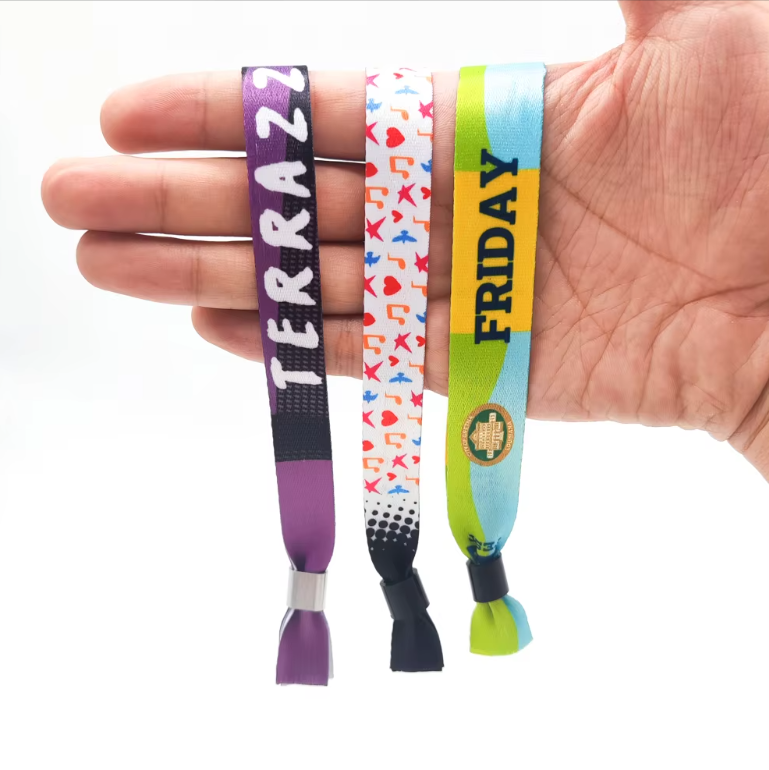
Festivals Push Credentials Harder Than Any Other Event
A festival is not a conference. People sleep in tents, dance in mud, stand under sun for hours, and line up for food with hands full. The credential has to survive all of that without becoming a nuisance. Wrist bands solve this because they stay on the body, need no pocket, and do not interfere with movement. A festival attendee can hold a drink, raise both arms, or jump into a crowd without losing track of their access pass. That physical freedom is the first reason wrist bands have become standard festival equipment.
Multi-Day Wear Makes Durability a Hard Requirement
Most festivals run two or three days, some longer. A wrist band that fails on day one creates a cascade of problems: reissuing at the gate, verifying purchase history, and arguing with attendees who already waited in line. Paper bands fall apart after rain or sweat. Vinyl bands hold up but can crack and feel sticky in heat. Woven wrist bands, made from interwoven polyester threads, resist moisture and repeated flexing. They also feel soft enough to sleep in, which matters when camping is part of the festival. The material choice is not cosmetic. It determines whether the access system survives until the final act.
|
Wristband Type |
Multi-Day Durability |
Water Resistance |
Comfort for Sleeping |
Typical Festival Use |
|
Paper |
Low |
Poor |
Low |
Single-day entry only |
|
Tyvek |
Medium low |
Fair |
Medium low |
Short events, dry weather |
|
Vinyl |
Medium |
Good |
Medium |
One to three day festivals |
|
Woven |
High |
Excellent |
High |
Multi-day camping festivals |
The table makes the tradeoff clear. Festivals that ask attendees to keep a band on for 48 hours or more need a material that does not degrade with movement, sweat, or water.
Color Coding Becomes a Language Everyone Reads Instantly
At a festival, access levels multiply quickly: general admission, VIP, backstage, artist, media, staff, and sometimes age-restricted areas. Wrist bands turn those categories into a visual system that works from several meters away. A security guard does not need to stop a person and inspect a phone screen. A green band means one zone, a gold band means another. That speed matters when thousands of people are moving between stages. It also reduces confrontation because the rule is visible on the wrist, not buried in an app. The International Festivals and Events Association has noted that clear visual identifiers help reduce gate disputes and improve crowd flow. A wrist band is a low-tech tool that does exactly that.
A Rainy Festival Weekend Exposed the Paper Band Problem
During a three-day riverside music festival in southern China, organizers initially chose paper wrist bands to keep costs down. On the second afternoon, a heavy rain rolled through. Within an hour, hundreds of bands had peeled or become illegible. Staff at the VIP lounge could not tell paid guests from general admission. The organizer had to set up a manual reissue station, which created a second line and delayed entry to the main stage. The following year, the festival switched to woven wrist bands with locking clasps and four colors for four access tiers. Rain did not affect readability. Gate staff reported faster checks, and the reissue line disappeared. The lesson was simple: a wrist band that cannot survive the weather is not saving money, it is moving the cost to staff time and attendee frustration.
Beyond Access, the Band Becomes a Souvenir
Festival attendees often keep their wrist bands after the event. The band sits on a backpack, a keychain, or a drawer as a reminder of the weekend. That souvenir behavior extends the festival brand far beyond the gates. A well-designed woven wrist band with the festival name and year woven into the fabric can remain legible for months. A paper band ends up in the trash. For sponsors and organizers, that longevity is free advertising. The band becomes a small badge of identity that attendees wear to future events or show in photos. That emotional layer is something a mobile ticket cannot replicate.
A Manufacturer with Festival Experience Removes Guesswork
Festival organizers need wrist bands that arrive on time, survive weather, and match the color plan exactly. A supplier that focuses on identification wristbands understands these demands better than a general merchandise vendor. Vibbon, for example, has specialized in identification wristbands since 2007. Its production covers medical and entertainment styles, with steady output for markets across Europe, America, and the Middle East. That narrow focus means the locking mechanism, fabric tension, and color accuracy are treated as critical details, not afterthoughts. When a festival gates open and the first wave of attendees arrives, that predictability is worth more than a lower unit price.
Table of Contents
- Festivals Push Credentials Harder Than Any Other Event
- Multi-Day Wear Makes Durability a Hard Requirement
- Color Coding Becomes a Language Everyone Reads Instantly
- A Rainy Festival Weekend Exposed the Paper Band Problem
- Beyond Access, the Band Becomes a Souvenir
- A Manufacturer with Festival Experience Removes Guesswork