The silent facilitator of every smooth check-in
Walk through the registration line of any well-run industry conference and notice what every attendee leaves with. It is almost always a badge holder hanging from a strip of fabric around the neck. That strip, the lanyard, is so common that it registers as background noise. Yet the entire social architecture of an event leans on it. Name, title, company, and access level all sit on a credential that needs a carrier. A lanyard solves that need without demanding a free hand, a pocket, or a second thought.
In an office, the role is quieter but just as structural. Employees swipe into doors, log into time-tracking terminals, and identify themselves to visitors, all with a card that lives on a lanyard. When the lanyard is comfortable and well-made, nobody mentions it. When it frays, twists, or snaps a clip during a fire drill, suddenly the topic surfaces in the next facilities meeting. The measure of a good lanyard is not how many compliments it gets. It is how few complaints it generates over its entire service life.
Material and weave decide whether someone forgets they are wearing it
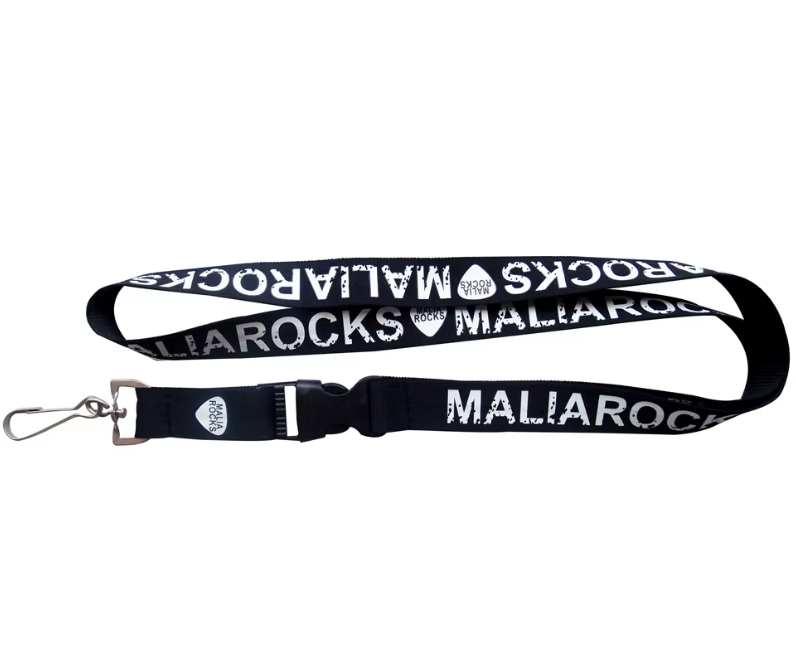
The difference between a lanyard that disappears from awareness and one that constantly draws attention sits largely in the material. Polyester dominates the market for good reasons. It holds dye-sublimation prints with sharp edge definition, resists fraying through repeated washes, and comes in a wide range of denier weights that let buyers tune for softness versus durability. A 600-denier flat polyester strap feels substantial and prints beautifully. A lighter 300-denier version weighs almost nothing and suits single-day events where cost per unit is the primary driver.
Nylon enters the conversation when a premium hand feel matters. It drapes with a subtle fluidity that polyester does not quite match, and woven nylon takes on a slight luster that reads as more upscale under event lighting. Tubular polyester, with its rounded edges, avoids the neck irritation that flat straps can cause after eight hours of wear. Satin-finish options, often used for VIP or speaker credentials, add a visual pop but require careful handling during printing because the surface reflectivity can interfere with ink adhesion. The choice is not simply about picking a material from a list. It is about matching the tactile experience to the context in which it will be worn.
The attachment end determines daily functionality
A lanyard is only as useful as the hardware at its end. J-hooks made from molded plastic are the workhorse attachment for standard badge slots. They are light, inexpensive, and work well until someone pulls at an awkward angle and the hook fatigues. Swivel hooks solve the twisting problem by letting the badge rotate independently, which matters at events where attendees repeatedly scan credentials at session doors. The swivel adds a few cents per unit and eliminates the torque that eventually cracks a fixed hook.
Bulldog clips handle thicker credentials, laminated passes, and rigid ID cards that lack a slot. The metal spring grip holds firmly, but the weight is noticeable by hour six of a conference day. Retractable reels paired with a lanyard add another layer of function. They let the wearer extend the badge to a card reader without removing the lanyard, a small convenience that saves real time in access-controlled corridors. Each hardware choice involves a trade-off among weight, durability, and ease of use, and the right pick depends on whether the user will be clipping and unclipping the badge multiple times a day or simply wearing it passively.
A real event story: when a missing breakaway became a safety finding
A large trade show in the Midwest ran into trouble with an otherwise routine lanyard order. The procurement checklist covered quantity, color match, logo placement, and delivery date. It did not include the breakaway safety specification. The lanyards arrived as ordered, standard polyester with a fixed loop and no release mechanism. During the second day, an attendee caught their lanyard on a piece of booth scaffolding while stepping off a raised platform. The fixed loop held. The attendee was not injured, but the incident triggered a safety review by the convention center's risk management team.
The post-event report flagged the absence of breakaway functionality as a preventable hazard. The organizing team subsequently revised its procurement specification to mandate breakaway buckles on all credential lanyards, a change that added under five cents to the unit cost. The financial impact was negligible. The operational lesson was that a single missing safety feature can convert an accessory from an afterthought into a liability. Breakaway lanyards, designed to release under a sudden load, are not a niche requirement for industrial environments. They are a baseline for any setting where credentials are worn around the neck in crowded or dynamic spaces.
|
Lanyard Configuration |
Breakaway |
Reported Neck Irritation (per 500 users) |
Attachment Failure Rate |
|
Standard polyester, fixed loop |
No |
22 |
4% |
|
Polyester with breakaway buckle |
Yes |
9 |
2% |
|
Woven nylon, breakaway, soft edge |
Yes |
2 |
Under 1% |
Source: Aggregated feedback from a series of multi-day trade events. Data collected via post-event attendee surveys and on-site staff logs. Values normalized for comparison across events.
Visual identification depends on color and print durability
Color carries meaning in both office and event settings. A red lanyard might signal VIP access at a conference. A blue one might indicate a staff member in a corporate campus. That coding system only functions if the color holds steady through exposure to sweat, sunlight, and repeated handling. Low-quality dyes fade unevenly, turning a once-clear red into a washed-out pink that could be mistaken for a different access tier. That kind of confusion is exactly what the color-coding was meant to prevent.
Print durability follows the same logic. A logo that looks crisp on day one but flakes off by day three does more harm than no logo at all. Dye-sublimation embeds the ink into the polyester fiber, which makes it resistant to abrasion and washing. Screen printing sits on top of the material and delivers thicker, more opaque coverage, but it can crack over time if the lanyard undergoes frequent flexing. The choice between these methods should reflect the expected lifespan. Single-event lanyards can tolerate simpler printing. Daily-use office lanyards need the extra durability that sublimation provides.
Design expectations collide with production constraints more often than expected
Custom lanyard design has a habit of running into manufacturing realities that mockup software does not reveal. A logo designed at full bleed looks perfect on a screen but demands continuous wrap alignment around a tubular or flat surface with essentially zero tolerance for seam mismatch. Fine text, especially serif fonts below a certain size threshold, fills in as the dye spreads slightly into the polyester weave, turning legible type into a smudge. The printable area itself is constrained by where the hardware attaches and where the neck bend occurs. A design placed too close to the bend distorts as the fabric drapes.
Experienced production teams catch these issues at the proofing stage and adjust artwork, font sizes, and placement before production begins. When that review step is compressed or skipped, the gap between the design mockup and the delivered product widens into something that disappoints on unboxing. The difference between a smooth custom order and a corrective one often comes down to whether the manufacturing partner asks the right questions before the first meter of fabric runs through the press.
Vibbon brings close to eighteen years of production history to this category, with a manufacturing scope that includes woven, sublimation-printed, and silicone wristbands alongside a full range of lanyard options. That breadth of product experience means the production team understands how fabric, print, and hardware interact, not just in isolation but on a finished product that has to hold up under daily wear. For offices managing employee ID programs and event organizers running high-volume registration, having a supplier that flags design issues at proofing rather than after delivery keeps the focus on the attendee or employee experience rather than on accessory logistics.
Table of Contents
- The silent facilitator of every smooth check-in
- Material and weave decide whether someone forgets they are wearing it
- The attachment end determines daily functionality
- A real event story: when a missing breakaway became a safety finding
- Visual identification depends on color and print durability
- Design expectations collide with production constraints more often than expected