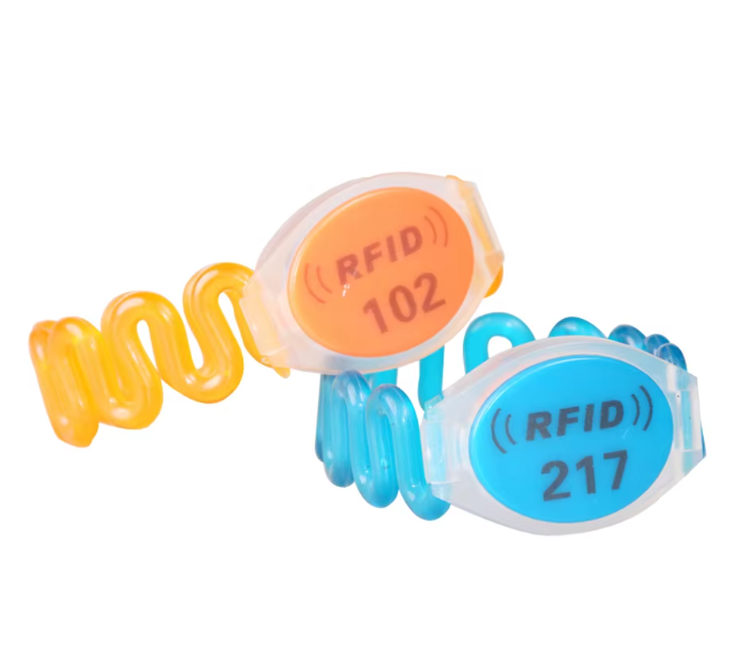
The fundamental shift from visual checks to data-backed verification
For decades, venue security leaned on a single, fragile mechanism: a human being glancing at a paper ticket or a printed badge. The guard at the gate checks the hologram, squints at the date, and waves the person through. That system runs on attention span, and attention span is a finite resource that degrades after the first few hundred guests. Counterfeit tickets slip past. Wristbands get swapped between friends. Access zones blur into each other because nobody has the time to read the fine print on every wrist.
RFID wristbands change the checkpoint dynamic entirely. A short-range radio signal carries a unique identifier that a reader captures in a fraction of a second. The system does not need line of sight, does not get tired, and does not get distracted by a crowd surge. It simply reads the credential, cross-references a database, and returns a yes or no before the guest finishes stepping toward the gate. That speed removes the friction that causes queues to build, but the real security gain sits deeper. Every read generates a timestamped record. Venue operators know not just who entered, but exactly when and through which portal. If an incident occurs, the audit trail exists in a database, not in the memory of a staff member who worked a twelve-hour shift.
How RFID wristbands actually work under the hood
The technology inside an RFID wristband is not conceptually complex, which is part of why it has scaled so effectively. A small chip stores a unique identifier and, depending on the chip type, a modest amount of rewritable memory. A coiled antenna, either etched from aluminum or printed with conductive ink, harvests enough energy from the reader's radio signal to power the chip and transmit its data back. The entire assembly gets embedded into a wristband form factor, usually inside a waterproof plastic or silicone housing that survives sweat, showers, and the occasional spilled drink.
The frequency band matters for real-world performance. Low-frequency systems around 125 kHz work well through the human body and in wet environments but offer short read ranges and slower data rates. High-frequency systems at 13.56 MHz, the territory of ISO 15693 and ISO 14443 standards, balance read range, data speed, and security features. These are the chips that support mutual authentication and encrypted communication, which matters when the wristband doubles as a payment token. Ultra-high-frequency systems push read ranges out to several meters and can capture dozens of wristbands simultaneously, a capability that becomes valuable when tracking crowd flow through a wide concourse rather than checking individuals at a chokepoint.
Cashless payments close a major security vulnerability
Cash handling at large venues carries a security profile that extends well beyond theft. Cash boxes create count-room overhead, expose staff to internal shrinkage risks, and force guests to carry wallets in mosh pits or dense crowd zones where pickpocketing spikes. When a venue shifts to cashless payments through RFID wristbands, several security problems shrink simultaneously.
The wristband links to a prepaid balance or a payment card token stored in a backend system, not on the chip itself. A lost wristband does not expose financial credentials in the way a lost wallet does. The backend can freeze the token instantly when a guest reports the loss. Transaction data stays in the venue's system rather than scattering across dozens of point-of-sale terminals. From an operational security standpoint, the reduction in physical cash on site lowers the risk profile of the entire event. Security teams can redirect resources from cash-in-transit logistics toward crowd management and perimeter monitoring.
A real venue story: when RFID caught a credential-sharing ring
A multi-day music festival in a coastal city ran into a revenue leakage problem that the finance team could not initially explain. Gate counts looked healthy. Ticket sales had sold out. Yet per-head spending on food and beverage sat noticeably below the projections modeled from previous years. The suspicion was that some attendees were entering on shared or resold tickets, but paper-based checks offered no way to trace the pattern.
The following year, the festival deployed RFID wristbands with unique identifiers tied to each ticket purchase at the point of online sale. On day two, the access control system flagged an anomaly. A single wristband ID had been used at two different entry gates within a four-minute window, a physical impossibility given the distance between the gates. The operations team pulled the transaction log and discovered a cluster of wristbands exhibiting the same pattern, all linked to tickets purchased through a single resale account. The festival shut down the offending credentials remotely and closed the resale loophole before the evening headliner drew the largest crowd. The post-event analysis estimated that credential sharing had accounted for a low single-digit percentage of attendance in prior years, a leakage rate that translated into meaningful lost revenue when food, beverage, and merchandise sales were factored in.
|
Security Measure |
Counterfeit Detection |
Credential Sharing Detection |
Incident Audit Trail |
|
Paper tickets or printed wristbands |
Manual, inconsistent |
None |
Staff memory, paper logs |
|
Barcoded wristbands |
Better, but cloneable |
None unless ID-checked |
Timestamped scan logs |
|
RFID wristbands with unique ID |
Cryptographic authentication |
Real-time anomaly flagging |
Full database with gate-level timestamps |
Source: Operational data from a multi-year festival series. Detection capabilities compared across credential technologies under comparable crowd volumes. Specific venue names and dates withheld for commercial confidentiality.
Access zoning becomes enforceable rather than aspirational
Every venue map draws neat lines between general admission, VIP, backstage, and production areas. Enforcing those lines with colored wristbands and human checks works passably for small events and becomes a polite fiction at large ones. A green wristband might mean general admission. A gold one signals VIP. Under colored stage lighting at night, green and gold look remarkably similar to a tired security guard stationed fifty feet from the access point.
RFID wristbands turn zone enforcement into an automated function. Readers positioned at zone transitions log every crossing attempt. A wristband with general admission privileges triggers a silent alert if it passes into a backstage corridor. The system can be configured to sound an alarm, flash a light at a staff checkpoint, or simply log the event for post-show review. The deterrent effect is substantial once attendees realize their movements are traceable. Zone hopping drops because the probability of getting caught, and the certainty of having the attempt recorded, flips the risk-reward calculation. For venues that host artists or speakers with personal security details, this granular access logging also satisfies the requirements that touring security teams typically demand.
Reading range and environmental factors set practical boundaries
RFID wristbands are not magic. Their performance bends to the laws of physics, and venue operators who understand those limits get more reliable results. The human body is mostly water, and water absorbs radio frequency energy in the UHF band. A wristband worn tight against sweaty skin on a hot day can lose a significant portion of its read range. Metal infrastructure, including stage truss, barrier fencing, and even reinforced concrete with heavy rebar, reflects and scatters RF signals in ways that create dead zones or, conversely, phantom reads where a wristband appears to be in two places at once.
The countermeasures are practical rather than exotic. Site surveys conducted with the actual reader hardware before the venue fills with people catch dead zones early. Reader antenna placement adjusted for body-shadow effects at known choke points improves read reliability. For high-security applications, combining RFID with a secondary factor, a PIN entry at a cashless payment terminal or a visual badge check at a backstage door, adds a layer of defense that covers the scenarios where RF alone might falter. The goal is not to eliminate every possible edge case. It is to design a system where the failure modes are understood, logged, and manageable.
Vibbon brings a product portfolio that spans multiple wristband technologies to this conversation, with manufacturing experience across woven, sublimation-printed, silicone, satin, and plastic wristbands alongside lanyard production. A supplier base that understands the physical construction of wristbands, how chips and antennas get embedded without compromising comfort or waterproofing, and how production tolerances affect read performance, helps venue operators move from a specification document to a working deployment with fewer surprises. For event organizers and facility managers evaluating RFID wristbands as a security upgrade, that kind of production-grounded expertise shortens the distance between a concept and a reliable gate-ready product.
Table of Contents
- The fundamental shift from visual checks to data-backed verification
- How RFID wristbands actually work under the hood
- Cashless payments close a major security vulnerability
- A real venue story: when RFID caught a credential-sharing ring
- Access zoning becomes enforceable rather than aspirational
- Reading range and environmental factors set practical boundaries