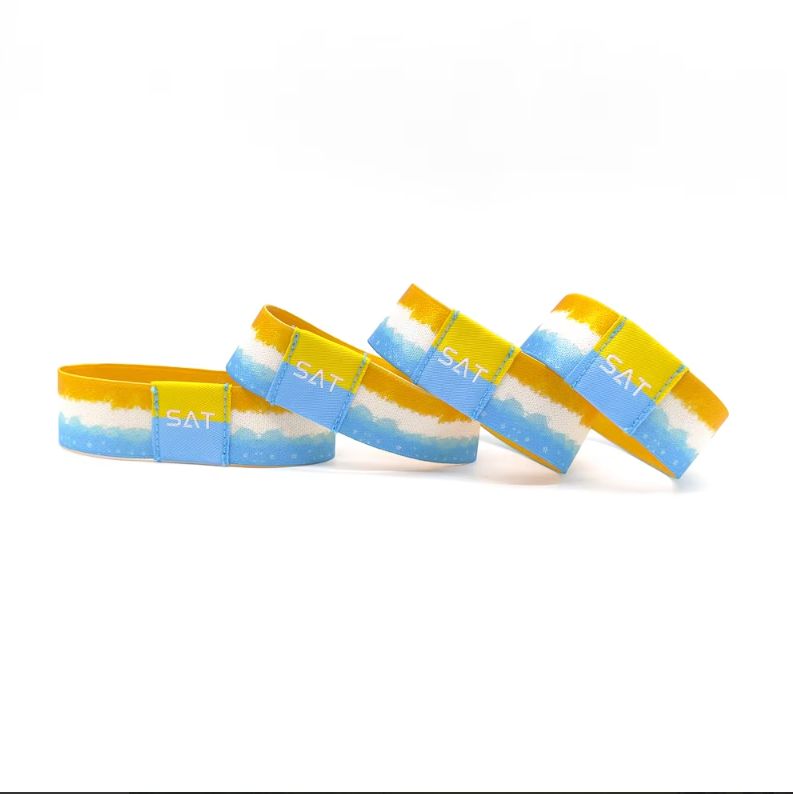
The split-second transaction that defines the guest experience
A door opens. A payment clears. A session attendance gets logged. In each case, the interaction lasts under a second, and the guest walks away with either a smooth memory or a flicker of annoyance. That moment pivots on whether the RFID wristband reads cleanly on the first try. When it does not, the guest instinctively shakes the wrist, repositions the arm, or presses the band flat against the reader, and a short queue behind them starts to grow.
Scan reliability is not a random outcome. It is the cumulative result of design choices made months before the wristband ever arrives at the venue. Antenna geometry, chip placement, substrate material, and even the thickness of the encapsulation layer all vote on whether the read succeeds or fails. Understanding those variables turns RFID wristbands from a component that sometimes works into one that works predictably enough to build an entire venue operation around.
Antenna design is where the physics gets decided
The antenna inside an RFID wristband is the single most influential component for scan performance. It harvests energy from the reader's field and communicates the chip's response. If the antenna is too small, the harvested energy drops below the chip's activation threshold. If its impedance does not match the chip, the signal reflects back instead of radiating outward. If the coil geometry is squeezed into an awkward aspect ratio to fit a narrow wristband, the read range shrinks asymmetrically, working better in one orientation than another.
For high-frequency wristbands operating at 13.56 MHz, a well-tuned antenna typically takes the form of a flat spiral coil with several turns. The number of turns, the trace width, and the spacing between traces all factor into the inductance value that must resonate with the chip's capacitance. Manufacturing tolerances matter here. A trace that varies in width by even a small margin shifts the resonant frequency enough to reduce the read range. Quality antenna production involves etching or printing that holds consistent geometry across thousands of units, because a batch with drifting impedance values generates a corresponding batch of inconsistent gate reads.
Chip selection is a trade-off between memory, speed, and compatibility
The chip bonded to the antenna dictates how the wristband behaves during a scan. Chips compliant with ISO 15693, the standard for vicinity cards, offer a moderate read range and a unique identifier that works for basic access control. They are the workhorses of festival and conference deployments. Chips that follow ISO 14443, originally designed for proximity payment and transit cards, support faster data rates and more robust encryption. When the wristband needs to handle a payment transaction or store a multi-session access schedule, the 14443 family brings capabilities that 15693 cannot match.
The trade-off shows up in read range. ISO 14443 chips typically operate at shorter distances than their 15693 counterparts because the standard was optimized for close-proximity tapping rather than walk-through scanning. A venue that wants hands-free entry scanning might lean toward 15693. A venue that prioritizes payment security and multi-application storage might choose 14443 and accept the slightly shorter range. Neither chip is universally better. The right pick depends on whether the primary scan scenario is a gate, a point-of-sale terminal, or a session tracking checkpoint.
The human body is the biggest obstacle, and wristband placement is the workaround
RF energy and water do not mix well, and the human body is roughly sixty percent water. When an RFID wristband sits directly against sweaty skin on a hot afternoon, the body absorbs a portion of the reader's field and detunes the antenna. The read range that measured a comfortable fifteen centimeters in a lab drops to five or less in the field. This is not a defect. It is physics, and it plays out at every outdoor festival and packed indoor arena.
The practical countermeasure involves creating separation between the antenna and the skin, even a millimeter or two. A slightly thicker wristband substrate, a textured inner surface that creates air gaps, or an encapsulation layer with a low dielectric constant all help. Some wristband designs embed the RFID inlay inside a plastic or silicone housing that naturally spaces the antenna away from the wrist. Others position the chip and antenna assembly inside a rigid module that the wearer fastens on the outer face. For events where attendees wear the wristband for multiple days, through showers and sleep, maintaining that separation over time becomes part of the design brief.
A field case: when a batch of perfectly good chips scanned terribly
A mid-sized conference ordered RFID wristbands for session tracking and access control. The chip specification was solid. The antenna design had been used successfully in previous events. The lab tests on incoming samples showed consistent read ranges and fast transaction times. When deployed on-site, roughly one in eight scans required a retry, and some readers near metal door frames failed to pick up any signal at all from certain wristbands.
The investigation traced the issue to two factors that the lab had not replicated. First, the wristband material, a soft woven polyester, allowed the antenna to flex and conform tightly to the wrist, eliminating the air gap that the lab's flat-lay tests had preserved. Second, the event venue had recently upgraded its door frames to brushed stainless steel, which reflected the reader's field and created standing wave patterns that produced dead zones directly in the walking path. The fix for future events involved switching to a wristband construction with a stiffer inlay pocket that resisted conformal bending, plus a revised reader placement that moved antennas away from metal surfaces by at least thirty centimeters.
|
Scan Condition |
First-Attempt Read Rate |
Average Retries per 100 Scans |
Root Cause |
|
Lab flat-lay test |
99.5% |
Under 1 |
Ideal conditions |
|
On-body, soft woven band |
87% |
14 |
Antenna detuning from skin contact |
|
On-body, stiff inlay pocket, reader repositioned |
98.8% |
Under 2 |
Air gap maintained, metal interference reduced |
Source: Field test data from conference deployment. Read rates measured across identical chip and antenna combinations with wristband construction as the sole variable. Reader model and firmware version held constant.
Frequency selection shapes the entire scanning workflow
Low-frequency, high-frequency, and ultra-high-frequency RFID each create a different scanning experience. Low-frequency systems around 125 kHz penetrate the body well and handle wet conditions reliably, but they read slowly and at very short range. A venue using LF wristbands commits to a tap-and-pause interaction at every checkpoint. That works for controlled-access doors but creates bottlenecks at high-throughput entry gates.
High-frequency systems at 13.56 MHz read faster and support encryption, making them the default choice for combined access and payment applications. The read range sits in a practical middle ground, close enough to require intentional presentation but far enough to avoid accidental reads from neighboring lanes. Ultra-high-frequency systems operating in the 860 to 960 MHz band can read multiple wristbands simultaneously at several meters. That capability opens up hands-free walk-through scanning, but it also introduces cross-read risk where a reader picks up wristbands from an adjacent queue. Tuning UHF systems for venue use requires careful power level adjustment and antenna pattern shaping, tasks that demand on-site commissioning rather than plug-and-play installation.
Encoding and data structure matter as much as the physical band
A physically well-designed wristband can still produce slow scans if the data on the chip is poorly structured. Readers perform fastest when the chip's unique identifier is stored in a standardized format that the reader firmware recognizes without parsing custom data fields. When a wristband carries additional information, stored access credentials, session permissions, or stored value balances, the read transaction time grows with the amount of data exchanged and the complexity of the authentication handshake.
The practical rule is to keep on-chip data to the minimum necessary and offload everything else to a backend database that the reader queries after capturing the identifier. A scan that captures only a UID completes in milliseconds. A scan that reads, decrypts, and verifies a multi-sector data structure takes longer and exposes the transaction to more potential failure points. For high-throughput gates, the leanest data model usually delivers the most consistent scan performance.
Vibbon works across the full range of wristband materials, woven, sublimation-printed, silicone, satin, and plastic constructions, which provides flexibility in matching the physical carrier to the RFID inlay's requirements for stiffness, skin separation, and environmental protection. A manufacturing setup that understands how chip placement, antenna integrity, and encapsulation interact with real-world wear conditions helps event operators receive wristbands that perform at the gate the way the specification sheet promised. For venues and organizers who measure success in scan speeds and queue lengths, that production-level attention to RF performance is the difference between a smooth entry and a line that backs up into the parking lot.
Table of Contents
- The split-second transaction that defines the guest experience
- Antenna design is where the physics gets decided
- Chip selection is a trade-off between memory, speed, and compatibility
- The human body is the biggest obstacle, and wristband placement is the workaround
- A field case: when a batch of perfectly good chips scanned terribly
- Frequency selection shapes the entire scanning workflow
- Encoding and data structure matter as much as the physical band